




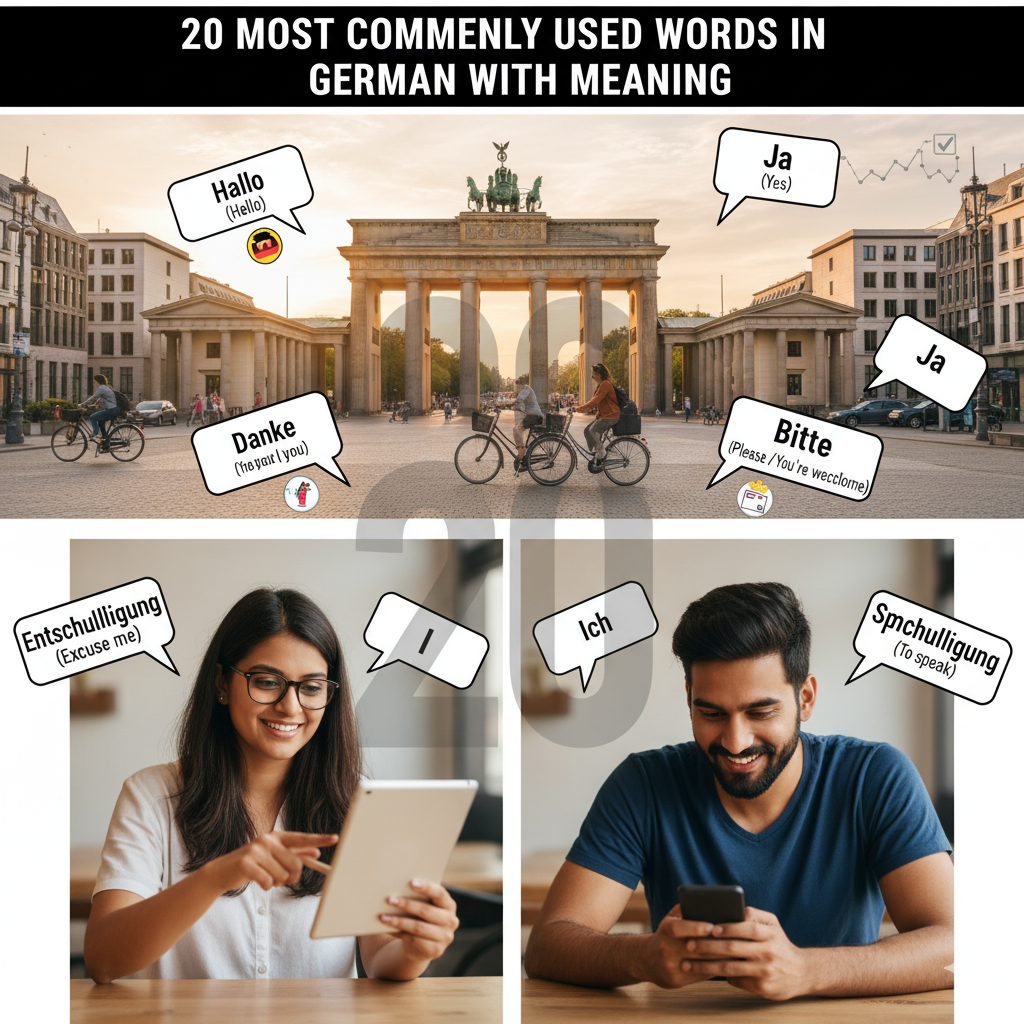
Learning German can be exciting, but starting with the most common words makes it easier to communicate from day one. Knowing these words helps you form simple sentences, understand conversations, and build a solid foundation.
Here are the 20 most commonly used German words along with their meanings:
Table of Contents
| Sr# | Words |
|---|---|
| 1 | Hallo |
| 2 | Ja |
| 3 | Nein |
| 4 | Bitte |
| 5 | Danke |
| 6 | Entschuldigung |
| 7 | Guten Morgen |
| 8 | Guten Abend |
| 9 | Gute Nacht |
| 10 | Tschüss |
| 11 | Wie geht’s? |
| 12 | Ich |
| 13 | Du |
| 14 | Er / Sie / Es |
| 15 | Wir |
| 16 | Sie |
| 17 | Essen |
| 18 | Trinken |
| 19 | Wasser |
| 20 | Haus |
1. Hallo – Hello
“Hallo” is the most basic greeting in German. You can use it in formal and informal settings.
- Example: Hallo! Wie geht’s? (Hello! How are you?)
2. Ja – Yes
A simple affirmative response.
- Example: Ja, ich verstehe. (Yes, I understand.)
3. Nein – No
Used to decline or negate something.
- Example: Nein, danke. (No, thank you.)
4. Bitte – Please / You’re welcome
- Can be used as “please”: Bitte, gib mir das Buch. (Please give me the book.)
- Or “you’re welcome”: Danke! – Bitte! (Thank you! – You’re welcome!)
5. Danke – Thank you
A basic expression of gratitude.
- Example: Danke für deine Hilfe. (Thank you for your help.)
6. Entschuldigung – Excuse me / Sorry
Used to apologize or get someone’s attention.
- Example: Entschuldigung, wo ist der Bahnhof? (Excuse me, where is the train station?)
7. Guten Morgen – Good morning
A polite greeting used in the morning.
- Example: Guten Morgen! Schön dich zu sehen. (Good morning! Nice to see you.)
8. Guten Abend – Good evening
Used when greeting someone in the evening.
- Example: Guten Abend, wie war dein Tag? (Good evening, how was your day?)
9. Gute Nacht – Good night
Used to say good night before going to sleep.
- Example: Gute Nacht! Schlaf gut. (Good night! Sleep well.)
10. Tschüss – Bye
A casual way to say goodbye.
- Example: Tschüss! Bis morgen! (Bye! See you tomorrow!)
11. Wie geht’s? – How are you?
A common way to ask someone about their well-being.
- Example: Hallo! Wie geht’s dir? (Hello! How are you?)
12. Ich – I
The first-person singular pronoun.
- Example: Ich bin müde. (I am tired.)
13. Du – You
Informal singular “you.”
- Example: Wie heißt du? (What is your name?)
14. Er / Sie / Es – He / She / It
Third-person singular pronouns.
- Example: Er ist mein Freund. (He is my friend.)
- Example: Sie ist meine Schwester. (She is my sister.)
- Example: Es ist kalt draußen. (It is cold outside.)
15. Wir – We
First-person plural pronoun.
- Example: Wir gehen ins Kino. (We are going to the cinema.)
16. Sie – They / Formal You
- They: Sie sind freundlich. (They are friendly.)
- Formal you: Wie heißen Sie? (What is your name?)
17. Essen – To eat / Food
- Example: Ich möchte etwas essen. (I want to eat something.)
18. Trinken – To drink
- Example: Willst du Wasser trinken? (Do you want to drink water?)
19. Wasser – Water
- Example: Ich brauche Wasser. (I need water.)
20. Haus – House
- Example: Das Haus ist groß. (The house is big.)
Conclusion
These 20 most commonly used German words are the foundation of everyday communication. Learning them will help you start speaking, understanding, and reading German confidently. Once you master these basics, you can gradually move on to sentences, phrases, and more complex vocabulary.
FAQs
1. How long does it take to learn basic German words?
With daily practice, you can learn and remember these 20 words in a few days.
2. Can I use these words in daily conversation?
Yes! These words are commonly used in greetings, introductions, and basic communication.
3. Are these words the same in Austria and Switzerland?
Mostly yes, but pronunciation and some expressions may vary slightly.
4. Should I focus on nouns or verbs first?
Start with common verbs and pronouns first, then gradually add nouns and adjectives.
5. Are these words enough to start speaking German?
These 20 words are just the beginning, but they form a strong foundation for basic conversations.




More Stories
Best AI Tools for Language Learning in 2025
How to Learn a New Language Without Classes
Easy Tips to Improve Vocabulary Fast