




Introduction
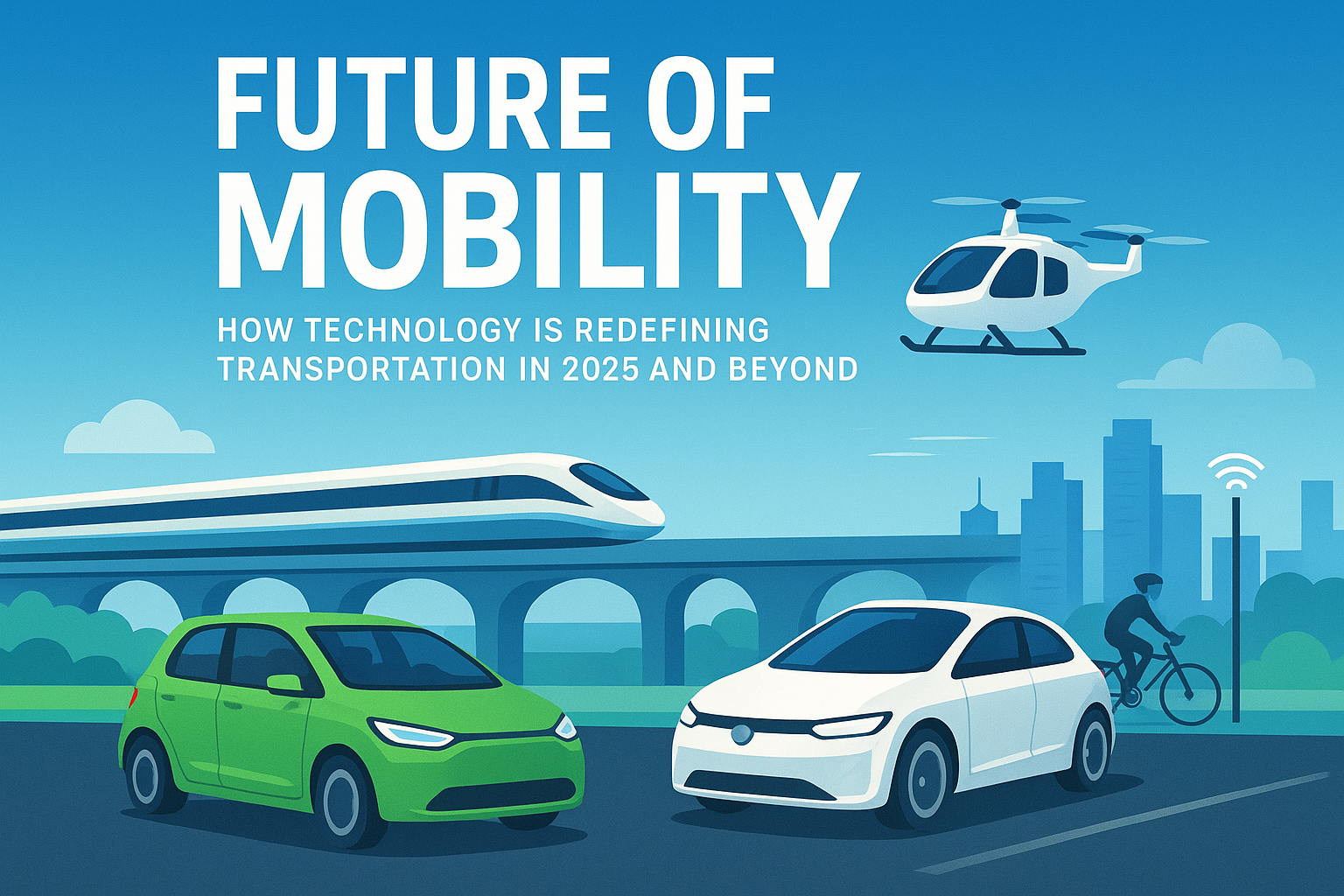
The way we move is changing faster than ever before. From electric cars to autonomous vehicles, flying taxis to hyperloop, the future of mobility promises to be smarter, greener, and more connected. As urban populations grow and sustainability becomes a global priority, innovative mobility solutions are transforming how people and goods travel.
In this blog, we’ll explore the key trends shaping the future of mobility, the technologies driving this revolution, and what it means for India and the world.
🔋 1. Electric Vehicles (EVs) Leading the Charge
Electric mobility is no longer a distant dream—it’s happening now. Governments and automakers are heavily investing in EVs to reduce carbon emissions and dependence on fossil fuels.
- Affordable EVs like Tata Tiago EV and MG Comet EV are making clean mobility accessible.
- Battery technology is improving, offering longer range and faster charging.
- Charging infrastructure is expanding in cities and highways, making EVs practical for daily use.
👉 By 2030, India aims for 30% electric vehicle adoption, creating a massive shift in the auto industry.
🤖 2. Autonomous & Self-Driving Vehicles
Imagine commuting without driving—your car takes you safely to work while you relax. Autonomous vehicles (AVs) are set to redefine mobility:
- Equipped with AI, sensors, and LiDAR for navigation.
- Promising fewer accidents by reducing human error.
- Companies like Tesla, Waymo, and even Indian startups are testing self-driving tech.
While full autonomy in India may take time due to traffic complexity, semi-autonomous features like adaptive cruise control and lane assist are already here.
🌍 3. Shared & On-Demand Mobility
Car ownership is slowly giving way to mobility-as-a-service (MaaS). Instead of buying cars, people prefer ride-hailing, car-sharing, and subscription models.
- Ola, Uber, and BluSmart are revolutionizing shared mobility.
- Subscription-based EV ownership is growing in metros.
- Reduced congestion and emissions make shared mobility vital for smart cities.
🚄 4. High-Speed and Alternative Transport Systems
The future of long-distance travel is equally exciting:
- Hyperloop: Elon Musk’s vision of ultra-fast pods could cut Delhi–Mumbai travel to under 2 hours.
- High-speed trains: India is working on bullet train projects to boost connectivity.
- Flying taxis & drones: Companies like Joby Aviation and EHang are testing air taxis for urban transport.
🌱 5. Sustainable & Green Mobility
Mobility of the future must be eco-friendly:
- Hydrogen fuel cells as an alternative to lithium batteries.
- Solar-powered vehicles being tested for energy independence.
- Cycling & micro-mobility (e-scooters, e-bikes) gaining popularity for short distances.
Governments worldwide are pushing for net-zero emissions, and mobility is central to achieving that goal.
📡 6. Connected Mobility & Smart Infrastructure
Vehicles are turning into smart devices on wheels.
- 5G connectivity allows real-time traffic updates and vehicle-to-vehicle (V2V) communication.
- Smart traffic management systems reduce congestion.
- IoT-enabled vehicles provide predictive maintenance, enhancing safety.
🚀 Future of Mobility in India
India’s mobility revolution is unique due to its urban density and affordability challenges. Expect to see:
- Rapid EV adoption in two- and three-wheelers.
- Shared electric mobility in metros like Delhi, Bangalore, and Mumbai.
- Expansion of green public transport including e-buses and metro systems.
By 2035, India could emerge as a global leader in affordable clean mobility.
✅ Conclusion
The future of mobility is not just about moving from point A to B—it’s about creating a connected, sustainable, and efficient ecosystem that benefits people, businesses, and the planet. Whether it’s EVs, self-driving cars, or flying taxis, the coming decade will bring a revolution in how we travel.
🌟 One thing is clear: Mobility in 2025 and beyond will be cleaner, smarter, and more exciting than ever before.




More Stories
Tata Nexon EV vs. MG Comet EV: Which Electric Car Should You Choose in 2025?
Is MG Comet EV Worth It? Full Review of India’s Compact Electric Car (2025)
Is Renault Kiger Really the Best Compact SUV of 2025?